AI-assisted reporting
Designing the investigation layer for Tyro's merchant portal.


Executive summary
Tyro's merchant portal could generate a report. It couldn't answer a question. Merchants who wanted to know why Tuesday was bad exported three files, opened a spreadsheet, and finished the job in a other AI tool.
As Senior Product Designer I led the reframe from report generator to investigation space: 8 merchant interviews, the market analysis behind the direction, the AI interaction model, and the MVP scope negotiated with engineering and product.
At a glance
Design strategy & execution
Led research, strategy, AI interaction model, MVP scope, pilot design
8 interviews & market analysis
Retail and hospitality merchants, survey validation, and a competitor read across Stripe, Shopify and Square.
Portal, governed by the AI in UX framework
The framework I authored for Tyro's merchant products. Agentic reporting was its first application.
Shipped to pilot in August 2026
Live with a merchant cohort. Measuring behaviour and cost before scaling.
The problem
The portal answered which report? Merchants were asking why?
A merchant's question doesn't map to a report type. “Why was Tuesday bad?” needs someone to already know which three exports add up to an answer.
And once the data's out, interpretation is homework. Merchants know their numbers. They don't necessarily know what the numbers mean.
Meanwhile Stripe, Shopify and Square had already closed the gap between generating a report and exploring one. Intelligent reporting was becoming something merchants expect, not something that impresses them.
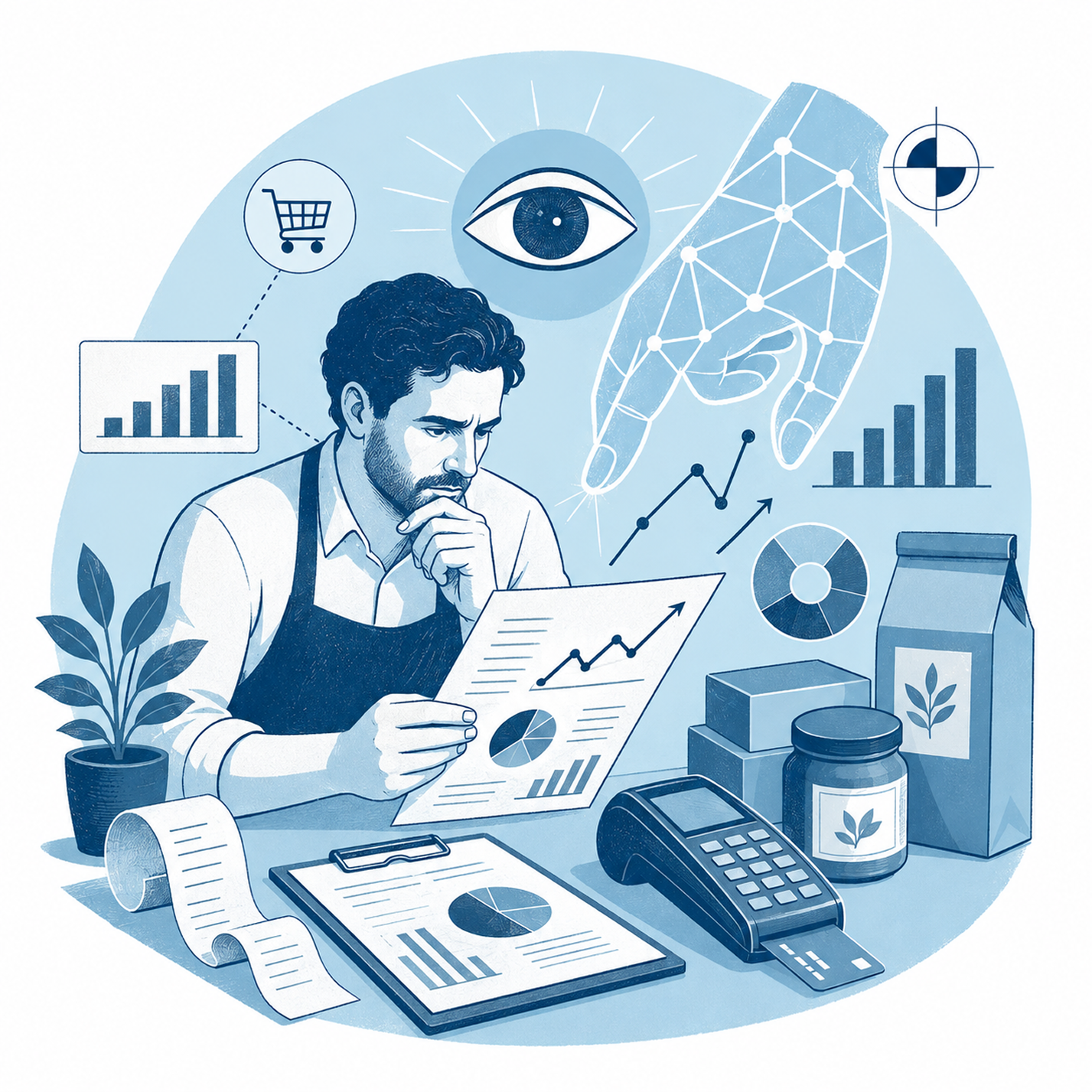
Nobody asked us for AI. They'd already built the workaround.
Every merchant we interviewed had assembled the same private analysis pipeline outside the product: export to a spreadsheet, paste into a general-purpose AI tool, interpret, then act.
“I usually export to Excel, then sometimes paste it into an AI tool to ask questions.” — Jon, 36, cafe owner
“Every Monday I run the same revenue and transaction reports. It's always the same steps.” — Daniel, 45, restaurant owner
A shadow workflow is what people build when the real one can't answer them. The need was already proven. The product just wasn't carrying it.
The research
The brief arrived as "AI report generator," which pointed at a better way to build reports. I went to merchants instead: 8 in-depth interviews across retail and hospitality, plus survey validation.
What I collected wasn't feature requests. It was the questions merchants actually ask about their own business, in their own words.
Almost none of them mapped cleanly onto a report the portal could produce. Answering one usually meant pulling two or three exports, combining them, and interpreting the result somewhere else.
That was the finding that reframed the work. We weren't missing a report generator. We were missing every question that didn't fit a report.
120+ quotes
Coded from 8 in-depth interviews with retail and hospitality merchants.
11 grouped by intent
Clustered by what a merchant was trying to find out, not by which report they'd have reached for.
The finding
Distilled to what answering them meant for merchant.
Eight merchants. Not one described their goal as a report.
Concepts
Chat-only generation
Each follow-up pushed the last answer off screen. Saving meant saving the thread, not the data. The output was a conversation, not a record.
Floating AI panel.
Available everywhere, minimises to a bubble. But merchants doing real analysis always maximised — and maximised was already a full page
The bet
The canvas, not the conversation.
We could have made the chat smarter, given the floating panel more room, or bolted an AI summary onto the existing export. Each of those makes one question easier to answer, and then the merchant is back where they started for the next one.
The bet we made instead was to invert the model: the report becomes the primary surface, and AI sits alongside it as a collaborator. That's the harder thing to build, because a persistent canvas has to hold state, save under a name, and stay correct whether a merchant assembled it by hand or asked for it. It meant accepting infrastructure and AI cost constraints we could have avoided by shipping a chat.
It was the only option on the table that left merchants holding something they could keep.
The solution
AI is the assistant. The report is the product.
The canvas holds the data and saves under a name. AI sits beside it — interpreting, suggesting the next question, never standing between a merchant and their own numbers.
Testing confirmed the model. It also confirmed the cost: a persistent, saveable canvas is heavier than a chat log, and open-ended AI has no cost ceiling.
We took it anyway. Reporting is the first place merchants will meet AI in Tyro's products, and the pattern set here — data primary, AI adjacent, assistance you can ignore — is the one every surface after it inherits.